
Spotlight: The King’s School Canterbury
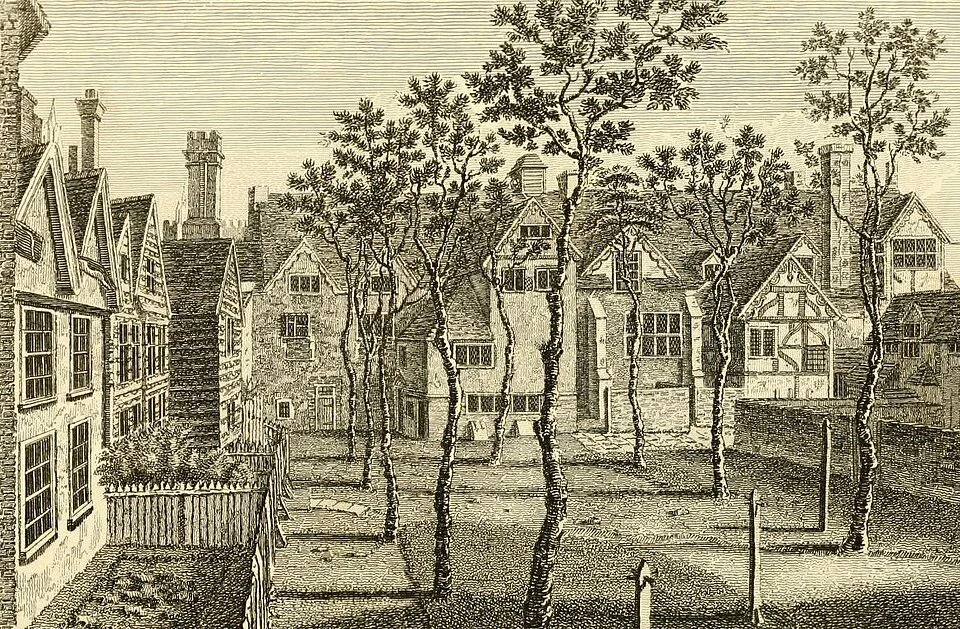
The King’s School, Canterbury by William Gostling (1696-1777)
September is back to school month for many, and so this instalment in our spotlight series focuses, appropriately, on a school, namely the King’s School in Canterbury, Kent. Quite possibly the oldest school in Britain, and one of the oldest in the world, the history of King’s is in some ways the history of education in Britain as a whole.
Dim and Distant Beginnings
Few institutions offer quite such a long view of British educational history as the King’s School, Canterbury. Closely connected with Canterbury Cathedral, its story reaches back to the arrival of St Augustine in Kent in 597 AD, when a monastery was established at Canterbury. The modern school is the inheritor of this long tradition, although its formal re-foundation came in 1541, following the dissolution of the medieval monastery and the reorganisation of Canterbury Cathedral under Henry VIII.
That distinction matters. It reminds us that the history of a school is not simply a list of famous former pupils, impressive buildings, or dates. Schools change because society changes. The story of King’s therefore provides an unusually rich starting point for asking a much bigger question: what did people in different periods think education was for?
Changing Thoughts
In medieval England, education was closely associated with the Church. Monasteries and cathedrals were important centres of learning, and the ability to read and write was particularly significant for those entering religious or administrative life. Canterbury’s position at the heart of medieval religious life makes its educational history part of a much wider story about knowledge, authority, and literacy.
The Reformation transformed that world. The dissolution of Canterbury’s monastery in 1540 and the cathedral’s re-foundation in 1541 took place during one of the most dramatic changes in English religious and political history. The school’s subsequent history can consequently be used to explore how education was affected by changes in religion, government, and ideas about society. This makes the King’s School particularly interesting for students studying the evolution of education through history, a key part of several GCSE history courses.
Teaching and Being
A school can make these enormous historical changes feel concrete. Instead of studying education only through legislation and statistics, students can ask what schooling actually looked like: who was allowed to receive an education? What subjects were considered worthwhile? Who paid for it all? How did discipline work? And how did opportunities differ according to class, gender, wealth, and geography?
Studying King’s in this way is not about declaring one school better than another. It is about using a remarkable historical case study to investigate the changing purposes of education itself. From medieval religious learning to the complex educational landscape of modern Britain, the history of one institution can open a door onto centuries of social and cultural change, and demonstrate that schools do not merely teach history: they are part of history themselves.
